
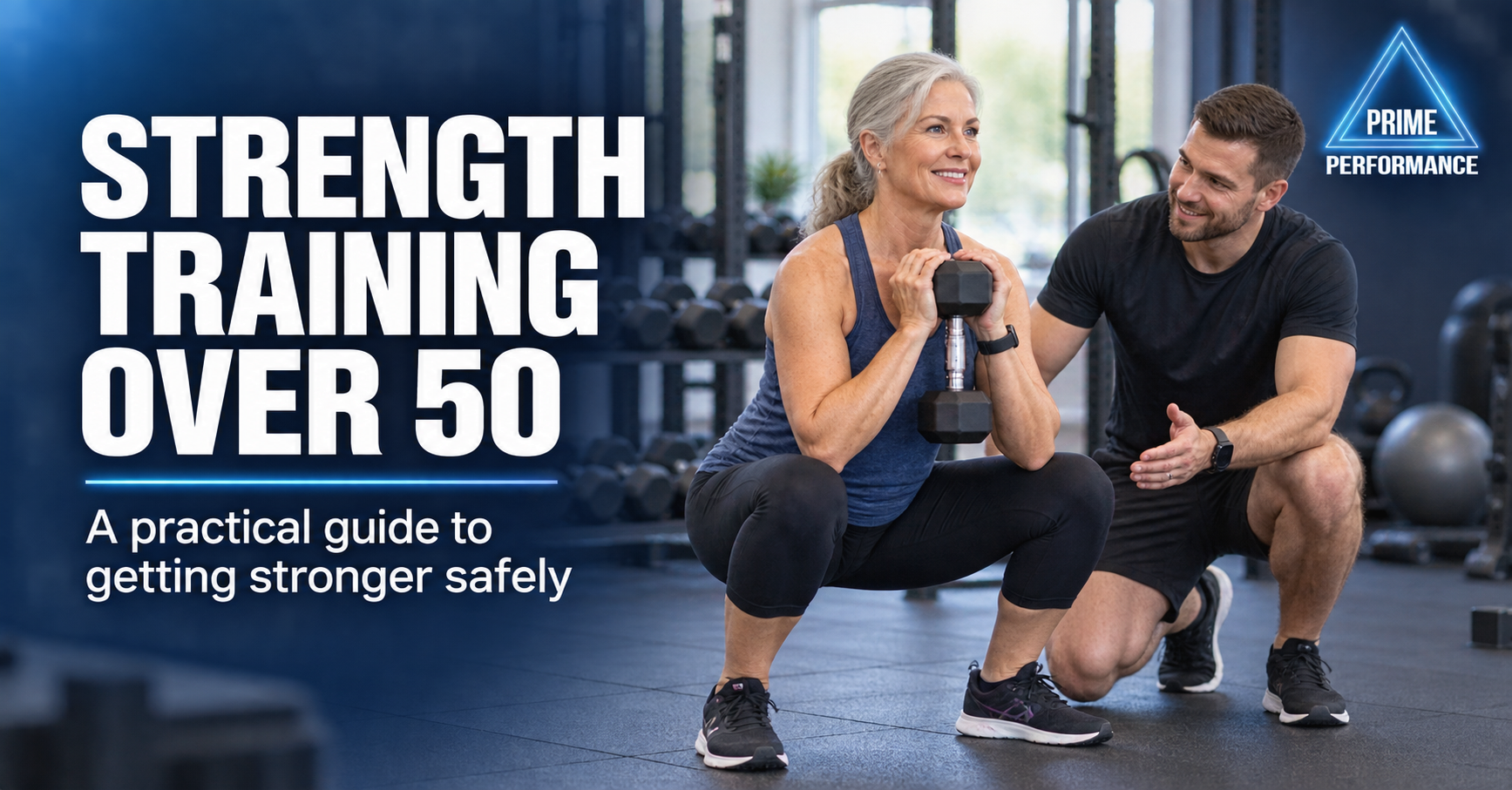
Strength training over 50 can be one of the most useful things you do to protect your independence, confidence and quality of life. You do not need previous gym experience or an athletic background. You simply need a sensible starting point, good technique and a plan you can repeat.
At Prime Performance Centre, we believe training should help you live better outside the gym. That might mean carrying shopping without discomfort, keeping up with your family, feeling steadier on your feet or returning to a hobby you enjoy.
Strength is not only about lifting heavy weights. It is a practical resource for everyday life.
Why strength training over 50 matters
Muscle mass and strength can gradually decline with age, particularly when everyday life becomes less active. However, your muscles remain responsive to training.
Regular resistance exercise gives your body a reason to maintain and build useful muscle. It also challenges your bones, coordination and balance.
The NHS guidance on strength and flexibility recommends performing muscle-strengthening activities on at least two days each week. These activities can help maintain bone density, improve balance and support everyday movement.
Everyday benefits you may notice
The benefits can include:
- More confidence when using stairs
- Greater ease when carrying shopping
- Better balance and control during everyday movement
- Improved posture
- Greater tolerance for physical tasks
- More energy
- A stronger sense of capability
- Support for long-term bone, joint and metabolic health
Progress is individual. Some people notice improvements in energy and confidence first. Others notice that everyday tasks begin to feel easier.
The aim is steady improvement rather than comparing yourself with somebody else.
Is it safe to start strength training after 50?
For most people, resistance training can be adapted to suit their current ability.
A sensible approach to strength training over 50 involves choosing appropriate exercises, learning to control each movement and increasing the challenge gradually.
If you have a medical condition, unexplained symptoms, a recent operation or a significant injury, speak to an appropriate healthcare professional before beginning.
A well-run gym should never expect you to know everything on your first day. At Prime Performance Centre, the gym is staffed during opening hours and new members receive an induction.
Personal training is also available in a private studio for anybody who would prefer individual guidance or a quieter training environment.
You can learn more about personal training at Prime Performance Centre or view our gym membership options.
The five foundations of a good over-50s strength plan
A successful programme does not need to be complicated. It should cover the main movement patterns, suit your current ability and leave enough time for recovery.
1. Train the major movement patterns
A balanced programme will normally include:
- A squat or sit-to-stand movement
- A hip hinge
- A pushing movement
- A pulling movement
- A loaded carry
- An exercise for trunk stability
These movement patterns transfer well to everyday life.
Machines, dumbbells, cables and bodyweight exercises can all be useful. There is no single piece of equipment that everybody must use.
2. Start with two full-body sessions each week
Two well-planned sessions are enough to build momentum for many beginners.
Leave recovery time between the sessions and keep your schedule realistic. Once the habit feels established, you can consider adding a third session if it supports your goals and recovery.
Consistency is more valuable than following an ambitious schedule for a few weeks and then stopping.
3. Use a weight you can control
The final repetitions should feel challenging, but your movement should remain smooth and repeatable.
You do not need to train to complete exhaustion. An appropriate early target could be one to three sets of approximately eight to twelve controlled repetitions.
The suitable number will depend on the exercise, your current ability and the purpose of the programme.
4. Progress one small step at a time
Progress does not always mean adding more weight.
It can also involve:
- Completing an additional repetition
- Improving your range of movement
- Using slightly more resistance
- Performing the movement with better control
- Feeling more confident with the exercise
- Needing less support from your trainer
Small changes are easier to recover from and add up over time.
5. Treat recovery as part of your training
Muscle develops between training sessions. Therefore, recovery is part of the programme rather than time away from it.
Regular sleep, adequate food, protein, hydration and lower-intensity movement can all support recovery.
Persistent joint pain, unusual fatigue or a clear drop in performance may be signs that the training load needs to be reduced. Seek appropriate professional advice if symptoms continue or concern you.
A simple first-session example
A beginner’s first strength session might include:
- Five to ten minutes of comfortable movement and mobility
- Leg press or a supported squat
- Seated row
- Chest press or an elevated press-up
- Hip hinge movement or hamstring exercise
- Farmer carry or a suitable core exercise
This list is only an example.
Your mobility, training history, health and goals should guide the final programme. Technique matters more than how impressive the workout looks on paper.
If you are completely new to training, our beginner’s guide to the gym in Ribble Valley explains what to expect before you walk through the door.
Common worries about starting strength training
It is normal to have concerns before joining a gym or beginning a new form of exercise. However, a suitable programme should be adapted around your starting point.
“I am too unfit to join a gym”
You do not need to become fit before you start.
A suitable programme begins at your current level and builds from there. The exercises, resistance and number of repetitions can all be adjusted.
“Strength training will make me bulky”
Building a large amount of muscle requires considerable time, targeted training and appropriate nutrition.
Most beginners experience improvements in strength, firmness and everyday function without suddenly becoming bulky.
“My joints are too stiff”
Exercises can often be adjusted by changing the range of movement, resistance, equipment or starting position.
Pain should not be ignored. However, stiffness does not automatically mean that you cannot train.
“Everyone else will know more than me”
Everybody has to start somewhere.
Prime Performance Centre is designed to be a welcoming environment, with staff available to answer questions and help you use the equipment correctly. Membership numbers are also capped to keep the gym comfortable.
How Prime Performance Centre can help
Prime Performance Centre serves people from Clayton Le Dale, Blackburn, Clitheroe and the wider Ribble Valley.
Our memberships are capped to prevent the gym from becoming overcrowded. A friendly member of staff is also available during opening hours if you need help.
New members receive an induction that introduces the facilities, equipment and relevant safety information.
If you would like more individual guidance, our coaches can create a programme around your starting point, lifestyle and goals. Support can include:
- One-to-one personal training
- Personalised training programmes
- Online support
- Food-plan guidance
- Progress tracking
- Accountability
- Mindset and confidence coaching
The aim is to help you become stronger and more confident rather than making you dependent on a trainer.
Ready to build strength for life?
The best programme is not necessarily the hardest one. It is the programme you can perform safely, recover from and continue.
If you are considering strength training over 50, begin with clear guidance and a realistic plan. Book an induction or speak to the Prime Performance Centre team to discuss your starting point and the support available.